
Quick Summary
- Total Cost of Ownership (TCO):* The choice isn't just "unlimited users vs. per-user." Acumatica's resource-based pricing escalates with transaction volume, while NetSuite's renewal pricing can increase significantly after initial discounts. Model your five-year costs including middleware and module add-ons.
- Financial & Multi-Entity Complexity:* NetSuite has a material advantage for companies needing multi-book accounting (e.g., GAAP and IFRS), complex revenue recognition, and multi-subsidiary consolidation. If you plan to grow through acquisition or internationally, NetSuite's architecture is more mature.
- Manufacturing & Distribution Fit:* Acumatica often delivers better value for discrete manufacturers and distributors with large shop-floor or warehouse teams, thanks to its unlimited-user model and strong, native manufacturing and distribution editions.
- Customization & Lock-In:* NetSuite's SuiteScript offers deep customization but creates significant "partner lock-in," making your custom code expensive to maintain if you switch partners. Acumatica's .NET-based platform is more open but has a smaller third-party app ecosystem.
- When to Look Elsewhere:* For services firms under 200 employees, Sage Intacct is often a better fit. For companies heavily invested in the Microsoft stack, Dynamics 365 Business Central offers tighter integration.
Nearly every Acumatica vs NetSuite comparison you will find online is written with a predetermined conclusion. If the article is from a NetSuite partner, it will methodically demonstrate why NetSuite is the superior choice. If it's from an Acumatica partner, it will inevitably find that Acumatica's modern architecture and pricing model prevail. As a business or IT leader, you can feel the bias baked into the analysis.
This article is different. It evaluates both platforms against the operational realities of mid-market companies at distinct stages of growth and complexity. The right answer depends entirely on your transaction volume, entity structure, manufacturing requirements, and integration architecture not on which vendor's logo is on the page.
Here, we will dissect the decisions that actually matter: the real total cost of ownership (TCO), financial management depth, multi-entity and international scalability, manufacturing and distribution fit, and the long-term risks of customization and integration. We will also cover the scenarios where, frankly, neither platform is your best choice.
The Real Total Cost of Ownership: Why Per-User vs. Resource-Based Pricing Is Only Half the Story
Most TCO models comparing Acumatica and NetSuite fixate on the headline licensing difference unlimited users versus per-user pricing while completely missing the cost layers that determine what you actually pay over five years.
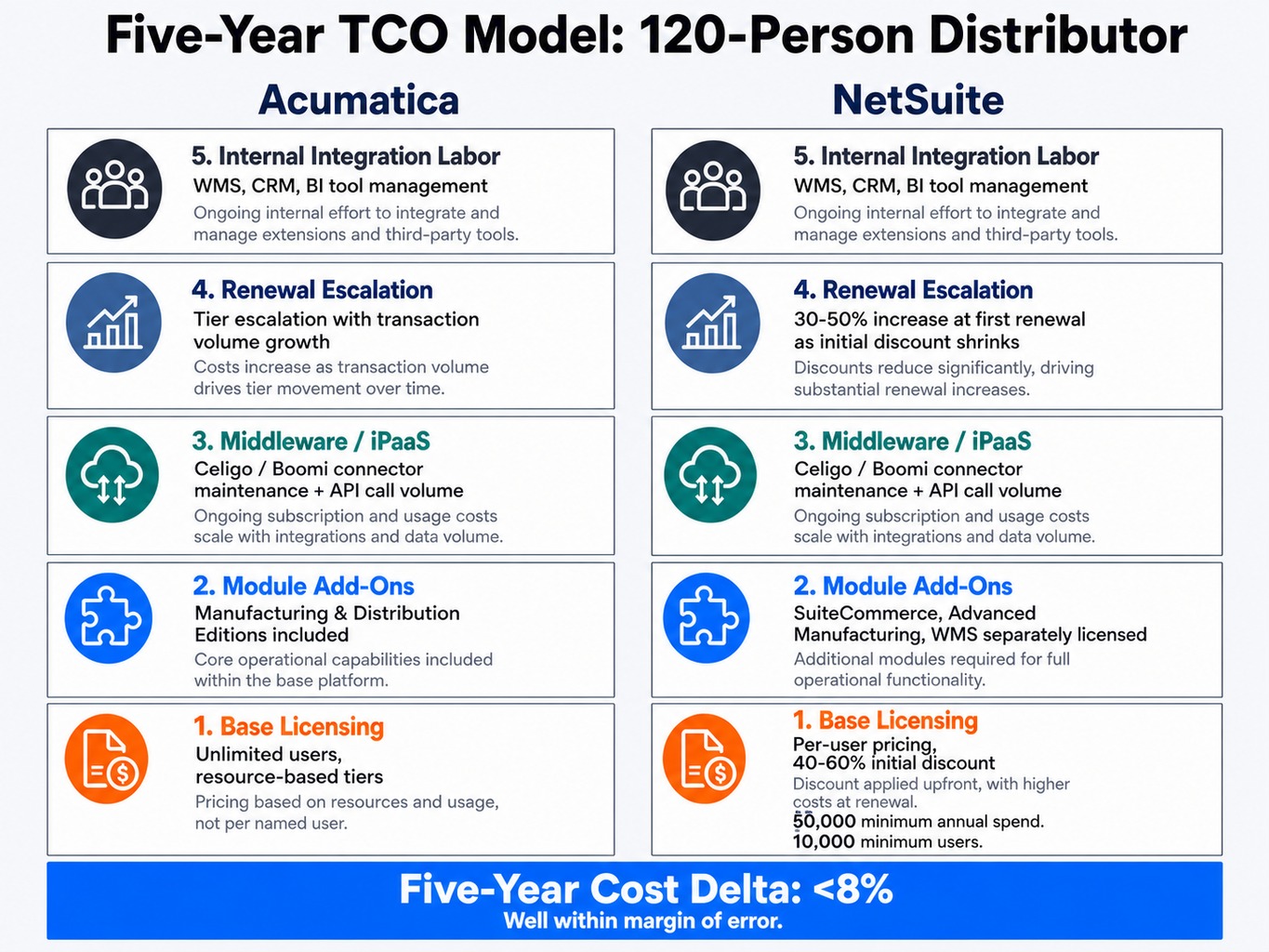
Consider a 120-person distribution company evaluating both platforms. At face value, Acumatica looks far more economical because adding 30 seasonal warehouse workers incurs no additional per-seat licensing cost. However, a proper TCO model must account for the transaction volume tiers on Acumatica, the cost of the SuiteCommerce module on NetSuite for a D2C channel, the licensing for middleware like Celigo integrator.io or Boomi to connect a separate WMS, and the renewal pricing trajectory that Oracle applies to NetSuite contracts.
During a TCO analysis for a distributor in this exact situation, the licensing cost delta looked decisive in Acumatica's favor. But once we modeled the annual connector maintenance, API call volume, and internal labor to manage integrations with their WMS, CRM, and BI tools, the five-year cost difference between the two platforms shrank to less than eight percent well within the margin of error. The initial licensing headline was not the reality.
How Acumatica's Resource-Based Licensing Actually Works at Scale
Acumatica's promise of unlimited user seats is real, but it's not a free pass. The pricing is governed by consumption, primarily transaction volume tiers, storage, and compute resources. This means a company processing 50,000 sales orders per month will pay a meaningfully higher subscription than a company with the same user count processing only 10,000. This is Acumatica's core mechanism for scaling its price with your business growth.
This resource-based pricing model has critical implications. For a professional services firm where most users are light-touch project time-sheet entrants, the value is immense. For a high-volume distributor or e-commerce retailer, you can hit tier escalations faster than you anticipate, especially if you have heavy API loads from integrated systems. While Acumatica's Customer Bill of Rights provides protection against arbitrary renewal hikes, it does not freeze your pricing tier as your business and transaction volume grow. The "unlimited users" advantage is most tangible for companies with a high ratio of light-use employees (e.g., warehouse staff, field service reps, project managers), but it is not a blanket cost savings guarantee.
NetSuite's Per-User Model and the Renewal Pricing Reality
NetSuite's per-user pricing is straightforward to model for your initial term but can become unpredictable at renewal. As many NetSuite customers will attest, the common sales motion involves a significant initial discount, often 40-60% off list price, to win the deal. At the first renewal, however, that discount often shrinks, leading to price increases of 30-50% or more.
While you can mitigate this by negotiating a longer initial contract term of three or five years, that introduces its own business risk by locking you into the platform. Furthermore, the initial quote rarely includes the full cost. Critical modules like Advanced Revenue Management (ARM), Advanced Manufacturing, or SuiteCommerce are all separately licensed and can substantially increase the total subscription. The costs of necessary third-party applications from the SuiteApp marketplace represent another layer often deferred until post-selection.
With NetSuite, your per-seat cost is predictable within a contract term, but your total cost factoring in module add-ons and renewal pricing requires careful forecasting.
Financial Management: Where the Platforms Genuinely Diverge
For core accounting, both platforms are robust. But in financial management, NetSuite has its most defensible advantage, though it only matters for companies with specific complexity profiles.
Imagine a growing professional services firm with offices in the US and UK. This firm must report financials under both US GAAP and IFRS. NetSuite handles this natively through its Multi-Book Accounting feature, which can maintain parallel sets of books that post from the same source transaction. Combined with its Advanced Revenue Management (ARM) module for handling complex ASC 606 and IFRS 15 requirements, NetSuite provides a deeply integrated solution for global financial compliance.
Acumatica supports a multi-currency general ledger and has strong core financials, but it does not offer a native multi-book accounting feature. A firm needing dual-standard reporting would have to rely on external reporting tools like Velixo Reports or develop significant custom workarounds.
However, this advantage is situational. For a single-entity manufacturer that only reports under GAAP, Acumatica's financial suite is more than adequate, and its GL structure is often more straightforward to configure and manage without requiring SuiteScript. While some vendor comparisons claim Acumatica requires developers for GL changes, this is overstated; its use of generic inquiries (GIs) and GI pivot tables provides flexible reporting, though NetSuite's SuiteAnalytics Workbook and saved searches are generally considered more powerful for on-the-fly analysis by finance teams.
The takeaway is clear: NetSuite wins on financial complexity, particularly for multi-book and advanced revenue recognition. For companies with simpler financial structures, Acumatica is fully capable.
Read more: Answer Business Questions in Real-time With NetSuite SuiteAnalytics
Multi-Entity and International Operations: The Complexity Threshold That Changes the Answer
Multi-entity management is the area where the architectural gap between Acumatica and NetSuite is widest. A wrong ERP selection at the mid-market level typically surfaces not at go-live but eighteen to thirty-six months later, when the business hits a complexity threshold the platform cannot absorb without expensive re-architecture. As a firm that frequently inherits stabilization work on such projects, we at GSI, Inc. see this pattern repeatedly.
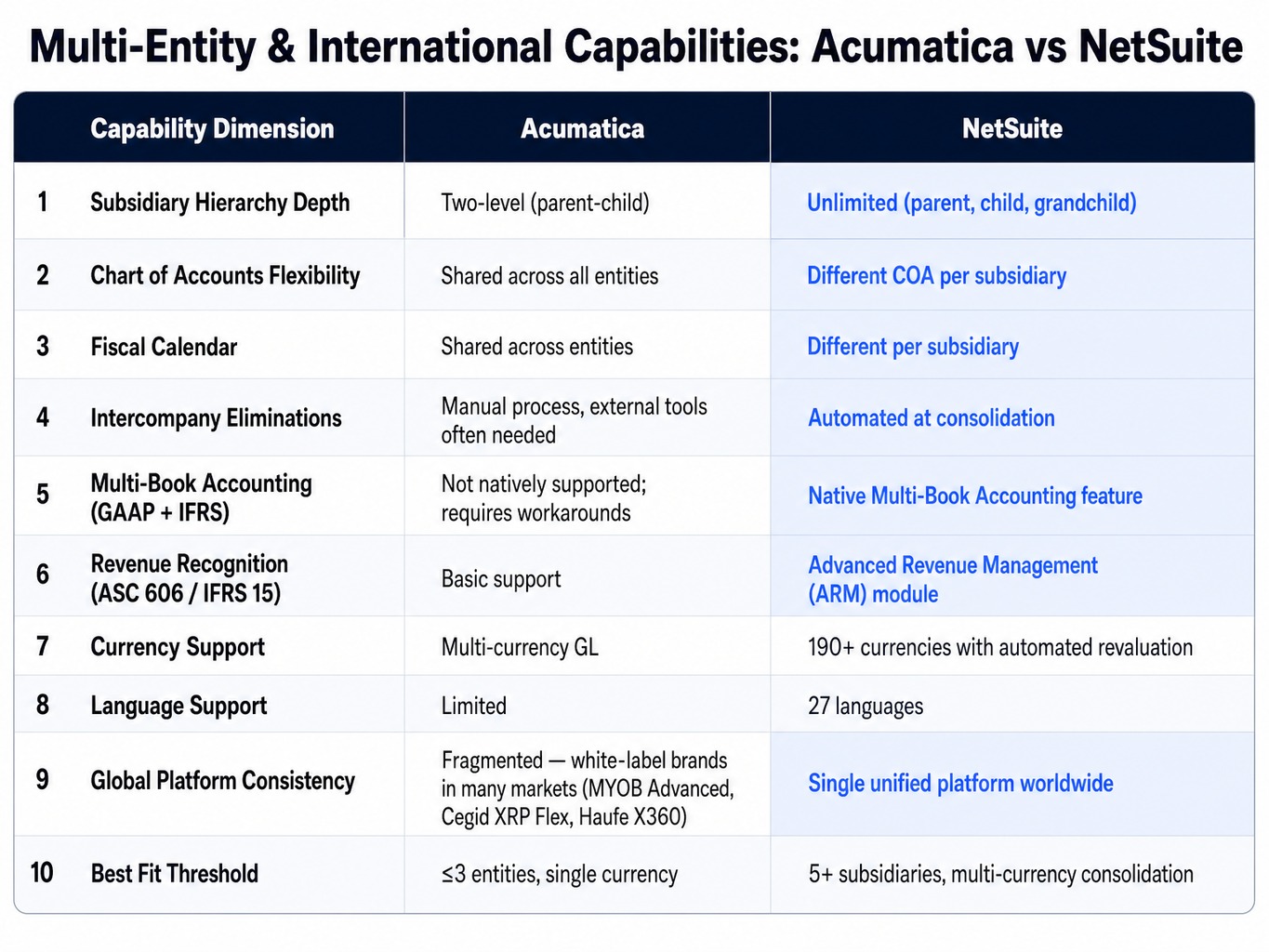
For companies with three or fewer legal entities operating in a single currency, either platform can work. But for organizations with five or more subsidiaries, significant intercompany transactions, and multi-currency consolidation needs, NetSuite's OneWorld architecture is significantly more mature. This is not a marginal feature difference; it's a fundamental architectural one.
Multi-Subsidiary Consolidation and Intercompany Accounting
NetSuite OneWorld was built from the ground up to manage complex subsidiary hierarchies (parent, child, grandchild) and automate financial consolidation in real time. It can handle entities with different charts of accounts, different fiscal calendars, and different functional currencies, automating intercompany transaction matching and elimination entries at the point of consolidation. In multi-entity consolidation, the critical differentiator is not just whether the platform supports intercompany transactions but how it handles these elimination entries and minority interest calculations, because that is where manual workarounds persist.
Acumatica supports multi-company and multi-branch structures, but it is architecturally limited to a two-level hierarchy and requires all entities to share the same chart of accounts. This becomes a major constraint when acquiring a new company with a different GL structure. Intercompany eliminations are a more manual process, and generating a consolidated financial statement requires more configuration and often relies on external reporting tools.
For a consumer goods company with a US headquarters, a Canadian distribution subsidiary, and a UK sales entity, NetSuite automates the period-end consolidation that would require a series of manual journal entries and spreadsheet work in Acumatica. Companies managing multiple subsidiaries benefit most from this architectural advantage.
Multi-Currency, Tax Localization, and the White-Label Question
NetSuite's global-first architecture is evident in its unified platform, which supports over 190 currencies and 27 languages with automated currency revaluation and native tax engine integrations.
Acumatica's international strategy is more fragmented. In many markets including Australia, France, Germany, and Scandinavia Acumatica is sold by other software companies under white-label brands like MYOB Advanced, Cegid XRP Flex, and Haufe X360. For a global company, this can mean dealing with different support channels, potentially varied release cadences, and a fractured partner ecosystem from country to country. While this is irrelevant for a single-country business, it creates significant friction for a company managing a global footprint. NetSuite provides a single, consistent platform experience worldwide.
Manufacturing, Distribution, and Warehouse Management: Where Acumatica Competes Hardest
While NetSuite leads in financial complexity, manufacturing and distribution is the vertical where Acumatica's feature set often matches or exceeds NetSuite's and where its licensing model creates the most tangible advantage.
Consider a 200-person discrete manufacturer with 80 workers on the shop floor who need system access for reporting labor on work orders, executing inventory moves, and performing quality checks. On NetSuite, licensing those 80 shop floor users is a significant and often prohibitive cost. On Acumatica, those users are included in the subscription, dramatically lowering the barrier to giving real-time data access to the entire operational team.
Beyond licensing, Acumatica's Manufacturing Edition and Distribution Edition are functionally deep. They include native Bill of Materials (BOM) management, Material Requirements Planning (MRP), production order management, and engineering change control. NetSuite offers similar capabilities through its separately licensed Advanced Manufacturing module, but Acumatica's offering feels more cohesive. For warehouse management, both platforms provide native WMS functionality with barcode scanning, but again, it is included in Acumatica's Distribution Edition while NetSuite WMS is another add-on module. For lot and serial number tracking, a critical need for many distributors, both platforms are capable, but Acumatica's implementation is generally seen as more intuitive for discrete manufacturing environments.
For manufacturers expanding into direct-to-consumer channels, both platforms integrate with tools like the Shopify Plus connector, but the overall value proposition for manufacturing and distribution companies especially those with a large operational headcount often tilts in Acumatica's favor.
Integration Ecosystem and the Customization Lock-In Risk
Both platforms advertise open APIs and rich third-party ecosystems, but the practical reality of building and maintaining integrations differs significantly. This difference compounds over time into a meaningful cost and risk factor.
NetSuite's SuiteCloud Development Framework (SDF), including SuiteScript and SuiteFlow, provides immense power to tailor the platform. However, this power creates a potent form of technical debt and lock-in. It's not just vendor lock-in; it's partner lock-in. A company that invests $200,000 in complex SuiteScript customizations built by one implementation partner will find that those scripts are often idiosyncratic and poorly documented, making them extremely expensive for a different partner to maintain or modify later. That $200,000 investment effectively becomes part of your switching cost.
Acumatica's xRP platform, built on standard Microsoft .NET and C#, with a consistent REST API, offers more architectural openness. In theory, customizations are more portable, and finding development talent is easier. However, its third-party marketplace, while growing, is less mature than NetSuite's SuiteApp.com. You will find deeper, more established connectors for NetSuite from partners like Celigo, Avalara, and Stripe. For complex, multi-system landscapes, both platforms will likely require an integration platform as a service (iPaaS) like Boomi or Celigo, a middleware cost layer that is frequently omitted from initial TCO projections.
NetSuite offers a deeper, more mature ecosystem at the cost of higher customization risk and lock-in. Acumatica provides more architectural freedom but with a thinner ecosystem that may require more custom integration work. Organizations looking to optimize their NetSuite environment should also consider the top customizations that deliver the most value.
When Neither Platform Is the Right Answer
Intellectual honesty requires acknowledging that this is not a two-horse race. For certain company profiles, neither Acumatica nor NetSuite is the best fit, and forcing one of them creates unnecessary cost and friction.
Here are two common scenarios:
The Mid-Market Professional Services Firm: For a services company under 200 employees with complex project accounting and revenue recognition needs but no inventory or supply chain, Sage Intacct is often a superior choice. Its dimensional reporting capabilities are best-in-class for slicing and dicing project profitability, and its implementation cost and timeline are typically lower.
The Microsoft-Centric Organization: For a company already deeply embedded in the Microsoft ecosystem running Dynamics 365 for Sales, using Power Platform for low-code apps, and hosted on Azure Microsoft Dynamics 365 Business Central is the path of least resistance. The native integration provides a more cohesive user experience and lower total cost of ownership than bolting on a third-party ERP.
If your business runs on Salesforce for CRM, the evaluation also changes. NetSuite's native CRM creates potential data silos and process redundancy, while Acumatica's Salesforce connector is functional but often requires middleware to handle complex logic. In all these cases, the "best" ERP is the one that fits your existing architectural and operational context.
How GSI Helps You Choose and Implement the Right ERP Not Just the Popular One
The central tension in any ERP selection is that the advice you get is almost always biased. As a NetSuite Solution Provider with a 20-year history also rooted in Oracle JD Edwards, Salesforce, and multi-cloud consulting, GSI's perspective is driven by operational fit, not a single vendor relationship. Our consultants, who average over 15 years of experience, have seen both Acumatica and NetSuite succeed and fail in different real-world contexts.
This experience is backed by a 100% service guarantee, which isn't a marketing slogan but a commitment to accountability. If an implementation doesn't deliver on the agreed-upon outcomes, we own the work to make it right. This focus on long-term success extends to our 24/7 managed services, which provide the post-go-live support and security oversight necessary to protect your investment.
Choosing an ERP is a high-stakes decision that extends far beyond a feature checklist. We act as your partner to pressure-test assumptions, model the real TCO, and ensure the platform you choose can support your growth trajectory for the next decade not just the next year.
Talk to a GSI consultant about which ERP fits your business stage and complexity.
Conclusion: It's About Fit, Not Features
The Acumatica vs NetSuite decision is not about which platform is objectively "better." It's about which platform's strengths and weaknesses align with your specific operational complexity, growth trajectory, and financial structure.
The choice crystallizes around a few key questions. NetSuite is the stronger choice for companies defined by financial and organizational complexity: those with multiple legal entities, international operations, and advanced revenue recognition or multi-book accounting needs. Acumatica competes most fiercely and often wins for mid-market manufacturing and distribution companies, where its unlimited-user licensing model provides a tangible economic advantage for large operational teams and its native industry editions are functionally deep.
For some, as we've seen, neither is the right answer.
Ultimately, the most expensive ERP decision you can make is not choosing the wrong platform. It is choosing the right platform but implementing it with the wrong partner. The capabilities on a vendor's slide deck only materialize through disciplined configuration, rigorous data migration, and a deep understanding of your business processes.
Frequently Asked Questions (FAQ)
How long does a typical NetSuite implementation take compared to Acumatica?
NetSuite implementations using the SuiteSuccess methodology typically run 3-6 months for mid-market companies, while Acumatica implementations average 4-8 months. Both timelines extend significantly with heavy customization, complex data migration, or multi-entity configurations. The platform choice matters less than your partner's discipline and your team's readiness for change.
How difficult is it to migrate from NetSuite to Acumatica or vice versa?
Migration between these platforms is a major undertaking, typically taking 6-12 months and costing 60-80% of a new implementation. Data mapping, workflow rebuilding, and integration reconfiguration cannot be automated. Critically, SuiteScript customizations in NetSuite are non-portable and must be rebuilt from scratch, making the switching cost higher than most companies anticipate.
Does Acumatica have a native ecommerce solution comparable to SuiteCommerce?
Acumatica offers a Commerce Edition with native B2B/B2C storefronts, but it is less mature than NetSuite's SuiteCommerce Advanced, which has deeper merchandising and promotional tools. Most Acumatica customers with significant ecommerce operations choose to integrate with best-of-breed platforms like Shopify Plus or BigCommerce rather than using the native module.
Which platform provides better real-time financial reporting out of the box?
NetSuite's SuiteAnalytics Workbook and saved searches provide more powerful and flexible native reporting for complex financial analysis, especially across multiple subsidiaries. Acumatica's generic inquiries and GI pivot tables are adequate for single-entity reporting but often require integration with Power BI or Velixo Reports for the multi-dimensional analysis that growing companies need.
How do Acumatica and NetSuite compare on AI capabilities in 2026?
Both platforms have introduced AI-assisted features NetSuite using Oracle's AI infrastructure for anomaly detection and forecasting, and Acumatica embedding ML for demand planning. However, neither platform's native AI is mature enough to replace dedicated analytics tools or human oversight. The value of AI in either ERP depends far more on your data quality than the platform's feature list.
Is Acumatica or NetSuite a better fit for companies scaling from 50 to 500 employees?
Both can support this range, but the answer depends on what is scaling. If your headcount growth is in warehouse or shop floor roles, Acumatica's unlimited user licensing offers a clear cost advantage. If your growth involves adding subsidiaries, entering new countries, or increasing financial complexity, NetSuite's multi-entity architecture handles that scaling path more gracefully.