
Key Takeaways
- HubSpot's mandatory onboarding fee ($1,500-$7,000) is a reference point, not your total implementation budget. For organizations with an ERP, it often represents less than 20% of the actual first-year cost.
- Partner implementation SOWs cover a wider scope, including discovery, custom object architecture, data migration, and integration, which is why their pricing reflects labor hours, not a flat fee.
- The single largest variable in implementation cost for manufacturing and distribution companies is ERP integration. A bidirectional NetSuite-to-HubSpot sync can add 80-120+ hours to an engagement.
- Evaluate partner quotes by their labor allocation, not just the total price. A quote that dedicates less than 15-20% of hours to discovery and architecture is a significant red flag for future rework.
- Your final budget should include line items for data migration, change management (10-15% of implementation cost), and a post-onboarding optimization retainer to manage the platform effectively.
HubSpot publishes its mandatory onboarding fees, which range from $940 to $7,500 depending on the hub and tier. Most organizations anchor their budget to that number, but the HubSpot onboarding cost on your invoice is the most visible figure and often the least useful one for accurate financial planning.
For a mid-market manufacturer or distribution company running an ERP like NetSuite, that fee typically represents 10-20% of the actual first-year implementation spend. We have seen this firsthand. Consider a distribution company that budgeted for HubSpot's published fee plus a partner SOW for basic setup. The real cost surfaced twelve weeks after go-live: a six-figure unplanned spend on middleware to sync HubSpot deal records with NetSuite sales orders, because the original scope assumed a simple data import rather than a real-time, bidirectional integration.
This article breaks down where your budget actually goes. We will cover HubSpot's direct fees, what a partner implementation scope includes, how ERP integration reshapes the budget, and the critical line items that finance and operations leaders routinely underestimate.
In this article: HubSpot's Published Onboarding Fees by Hub and Tier · What Partner Implementation Pricing Actually Covers · Where Onboarding Dollars Go · Budget Lines CFOs Miss · Multi-Hub Enterprise Deployments · How GSI Scopes HubSpot Implementations · The Right Way to Budget for HubSpot
Get a HubSpot Implementation Cost Estimate from GSI
GSI sells HubSpot and provides scoped implementation engagements, including a NetSuite-to-HubSpot integration. Organizations can request a cost estimate scoped around their specific process, data, and integration requirements.
HubSpot's Published Onboarding Fees by Hub and Tier
HubSpot requires a one-time onboarding fee for all new Professional and Enterprise tier subscriptions. The Starter tier does not carry this mandatory fee. These fees cover a series of guided calls with a HubSpot specialist to assist with technical setup, goal setting, and initial portal configuration.
The costs vary by the specific hub and tier you purchase.
| HubSpot Hub & Tier | Published Onboarding Fee |
|---|---|
| Marketing Hub Professional | $3,750 |
| Marketing Hub Enterprise | $7,500 |
| Sales Hub Professional | $1,875 |
| Sales Hub Enterprise | $3,750 |
| Service Hub Professional | $1,875 |
| Service Hub Enterprise | $3,750 |
| Content Hub Professional/Enterprise | $1,875 |
| Operations Hub Professional | $940 |
| Operations Hub Enterprise | $2,500 |
| Commerce Hub Professional | $1,250 |
Note: Fees are based on publicly available information as of early 2024 and are subject to change. Multi-hub bundles may have different onboarding fee structures.
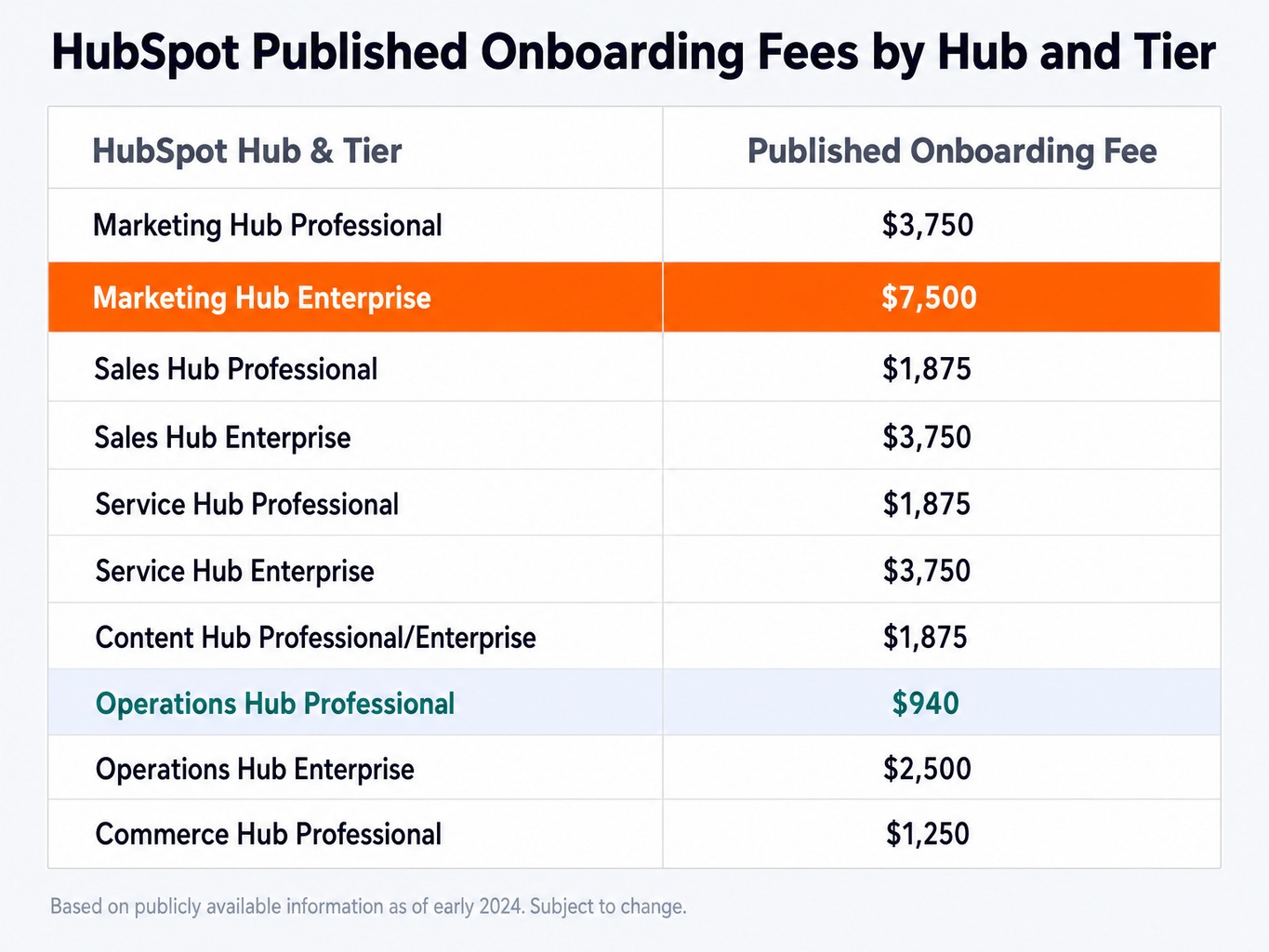
HubSpot allows accredited Solutions Partners to waive this direct onboarding fee if the partner is contracted to deliver the implementation. This doesn't eliminate the cost; it redirects your investment from HubSpot's guided program to a partner's more comprehensive Statement of Work (SOW). For organizations with simple requirements and strong internal technical resources, HubSpot's direct onboarding is a viable, structured path. For those with complex sales processes, legacy data, or ERP integration needs, the partner model provides a scope tailored to those needs.
Read more: HubSpot Onboarding Services
What Partner Implementation Pricing Actually Covers
A HubSpot partner implementation price is not a markup on the standard onboarding fee; it reflects a fundamentally different and more expansive scope of work. While HubSpot's direct onboarding guides you through the setup, a partner's SOW extends that work by translating your specific business processes into a functional, adopted platform architecture. The HubSpot implementation cost from a partner is based on the labor hours required to execute this, not a flat product charge.
SOW Components and How They Drive Cost
A typical partner SOW is broken into phases, and the cost is driven by the complexity of your organization's processes, not just the number of hubs you buy.
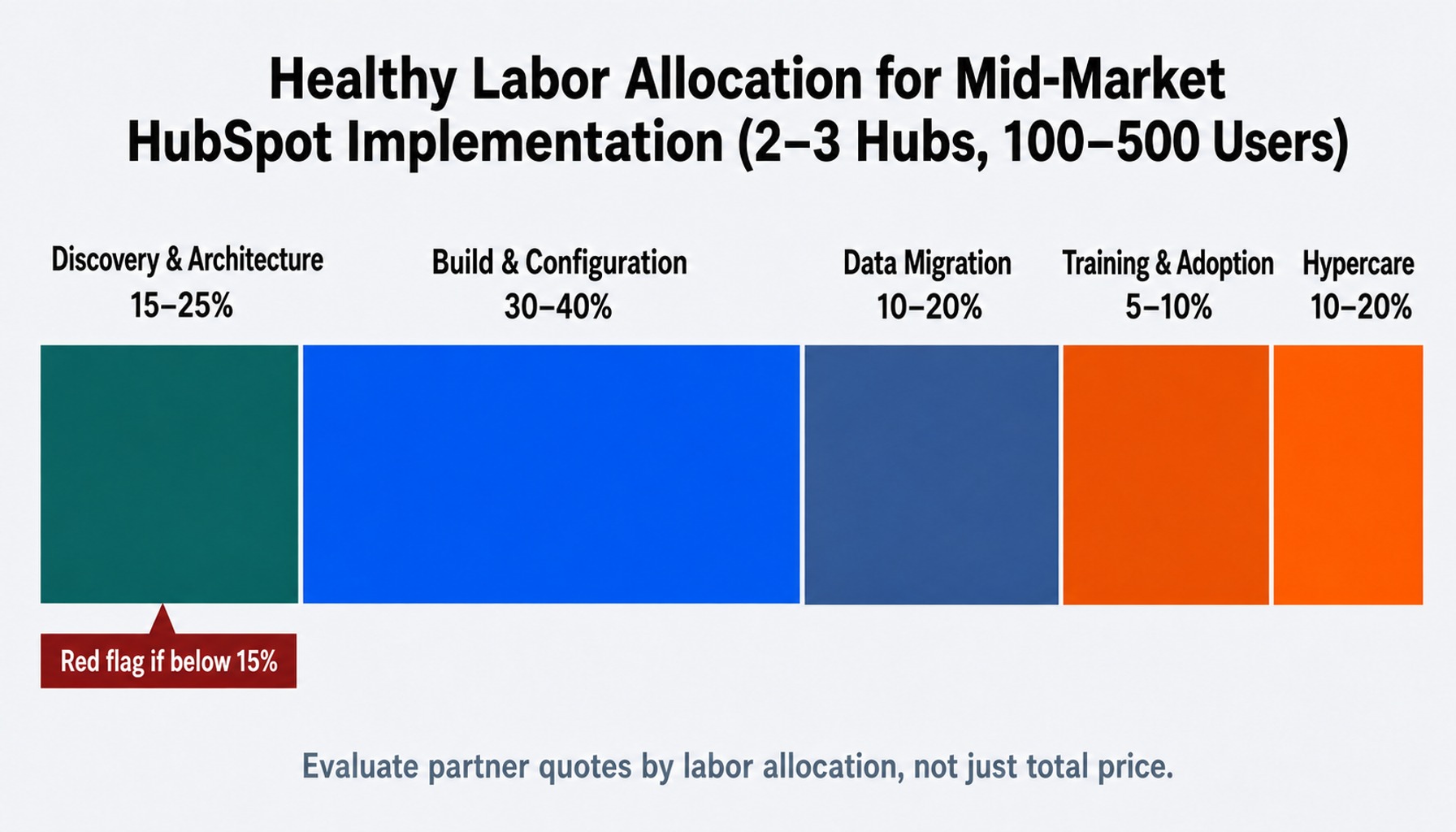
- Discovery & Architecture (15-20% of hours): This includes stakeholder interviews, mapping your sales, marketing, and service processes, and defining your lifecycle stages. This is where the technical blueprint is created for custom object schemas, association labels, and property mapping.
- Build & Configuration (30-40% of hours): This is the hands-on keyboard work: configuring deal pipeline stage gating, building the lead scoring model, setting up sequence enrollment triggers, writing calculated property logic, and creating custom reporting dashboards. A distribution company with three distinct deal pipelines and custom quoting workflows will have a materially larger build phase than a company with a single pipeline, even if both buy the same HubSpot licenses.
- Data Migration (15-20% of hours): This covers extracting, cleaning, mapping, and importing data from legacy systems. It involves creating a property mapping spreadsheet, handling deduplication, and validating the import of historical activities.
- Training & Adoption (10-15% of hours): This goes beyond platform demos to include role-based training on specific workflows, like the BDR-to-AE handoff process, and establishing adoption metrics.
- Hypercare (10% of hours): This is a 30- to 60-day post-launch support window to address user questions, fix minor issues, and ensure the system is stable.
How ERP Integration Reshapes the Implementation Budget
For manufacturing, distribution, and retail organizations, ERP integration is the single largest variable in the HubSpot partner pricing structure. When a mid-market organization underestimates HubSpot implementation cost by anchoring on the published onboarding fee, the budget gap typically surfaces as unplanned change orders during integration. Because that gap is predictable, it is best scoped as a defined workstream before the engagement begins.
A company running NetSuite or JD Edwards that needs bidirectional sync of customer records, sales orders, or inventory data is adding a significant workstream to the SOW. This involves API-based integration development, potential webhook relay architecture, sandbox environment provisioning for testing, and ongoing monitoring.
For example, a standard NetSuite-to-HubSpot integration that syncs customer and company records, surfaces open sales orders in HubSpot, and pushes won deals back to NetSuite can easily add 80-120+ hours of scoping, development, and testing to the engagement. While pre-built connectors from the HubSpot App Marketplace can reduce some of this effort, they rarely eliminate the need for custom mapping and logic, especially for organizations with non-standard data models or complex subsidiary structures in their ERP.
Where Onboarding Dollars Go: Labor Allocation Across Phases
Most executives evaluate implementation quotes by comparing the total price. The more diagnostic approach is to compare how the proposed hours are allocated across project phases. A quote that front-loads effort into discovery and architecture will almost always produce a more stable, scalable portal than one that rushes to the build phase. Under-investing in discovery doesn't save money; it just defers the cost into post-launch rework and change orders.
For a mid-market HubSpot implementation (2-3 hubs, 100-500 users), a healthy labor allocation generally follows the phase ranges outlined in the SOW components above.
If a partner quote allocates less than 15% of the total hours to discovery, you should ask why. We once saw a retail organization go straight to portal build to save time, only to realize three months later that their custom object schema couldn't support their wholesale vs. direct-to-consumer sales processes. The subsequent re-architecture and data re-mapping cost them nearly 40% of the original engagement budget. A proper discovery phase would have identified that process divergence on day one.
Budget Lines CFOs Miss: Hidden Costs Beyond the Onboarding Fee
The onboarding fee and the partner SOW are the visible costs. The budget lines that cause overruns are the ones that depend on your organization's readiness and are rarely included in an initial quote.
- CRM Data Migration: Moving data from a legacy system is not a simple export/import. For an organization with 50,000+ contact records and multiple data sources, the work of deduplication, field mapping, cleansing, and validation can easily consume 60-100+ hours. A manufacturer that failed to budget for this saw a six-week project delay and an unplanned $20,000 cost for data services.
- Change Management & User Adoption: Training sessions teach features; they don't guarantee adoption. A true change management program includes developing role-specific playbooks, creating internal champions, and establishing a 90-day adoption measurement plan. This investment, which typically adds 10-15% to the implementation budget, is a major factor in whether the implementation achieves positive ROI.
- Post-Onboarding Optimization Retainer: The portal you launch is not the portal you'll need in six months. Business processes evolve and HubSpot releases new features. Budget for a monthly retainer (e.g., 10-20 hours) to cover workflow refinement, reporting iteration, and governance to prevent configuration drift. Organizations without internal capacity for this work can cover it through HubSpot managed services.
- Long-Term Technical Debt: A poorly designed object schema for example, using hundreds of custom properties on a standard object instead of modeling a true custom object creates reporting and automation debt. This decision, made during the initial build, compounds over time and can eventually force a costly re-implementation.
Multi-Hub Enterprise Deployments: Why Phased Budgeting Beats a Fixed Quote
Enterprise organizations purchasing Marketing Hub, Sales Hub, Service Hub, and Operations Hub together often request a single, fixed-price implementation quote. This approach creates risk. The scope of Service Hub and Operations Hub depends heavily on architectural decisions like lifecycle stage mapping and custom object schema made during the Sales and Marketing Hub implementation.
A phased budgeting approach is a better risk management strategy. Scope and budget for Phase 1 (e.g., Marketing and Sales Hubs) first. Once that foundation is stable and adopted, you can scope Phase 2 (e.g., Service and Operations Hubs) with much greater accuracy.
Consider an energy company that deployed Marketing and Sales Hub Enterprise in Phase 1. Six months later, they initiated Phase 2 to add Service Hub and Operations Hub. The Phase 2 SOW was 30% smaller than originally estimated because the new configurations for service pipelines and custom-coded actions could leverage the stable data architecture and validated processes from Phase 1. While multi-hub license bundling can offer subscription discounts, the implementation budget should still be phased to align with your team's capacity to absorb change.
Read more: HubSpot Leads, Lifecycle, and Pipeline Stage Overview
How GSI Scopes HubSpot Implementations for Manufacturing, Distribution, and Enterprise Organizations
The central challenge of budgeting for a HubSpot implementation is that the real cost drivers ERP integration, complex data models, and phased rollouts require more than just portal configuration skills. They also call for experience with enterprise applications and business process design.
At GSI, we sell HubSpot and deliver scoped implementation engagements that account for the cost drivers described above. Our SOWs cover discovery, portal architecture, workflow automation, and user adoption. We also sell and implement a NetSuite-to-HubSpot integration, drawing on our NetSuite expertise, and treat it as a core workstream within the engagement. GSI brings ERP implementation experience to this integration work. Addressing ERP integration requirements upfront is intended to reduce the risk of the unplanned change orders that many manufacturing and distribution companies face.
To discuss your HubSpot implementation needs and budget, contact GSI and we will scope an estimate around your process, data, and integration requirements.
The Right Way to Budget for HubSpot
The HubSpot onboarding fee is a starting reference, not your budget. The published HubSpot onboarding pricing tells you what the vendor charges for guided setup, but your actual implementation budget is a function of your own complexity. It is shaped by your data migration needs, your ERP integration requirements, your custom object architecture, your investment in change management, and whether you phase multi-hub deployments or attempt to launch everything at once.
Before you request a single quote, build an internal requirements document. Map your sales process, identify all data sources, define your integration points, and set a realistic adoption timeline. That document not a vendor's fee schedule is the foundation of an accurate and defensible implementation budget.
Frequently Asked Questions
1. How long does a typical mid-market HubSpot onboarding engagement take?
HubSpot's own guided onboarding for a single Professional-tier hub typically runs 60-90 days. A full partner implementation for a mid-market organization deploying two or more hubs with data migration and integration usually takes 3-5 months from kickoff to the completion of the hypercare period, depending on data readiness.
2. What ongoing costs should we expect after HubSpot onboarding is complete?
Plan for three recurring costs beyond your subscription: a monthly optimization retainer (typically 10-20 hours/month for workflow and report refinement), potential contact-tier overages as your database grows, and periodic re-training as HubSpot releases features or your team turns over. Most mid-market firms budget $2,000-$5,000/month for this.
3. How does adding Operations Hub to an existing portal affect implementation cost?
The cost impact depends on your use case. Adding Operations Hub for its data quality automation or advanced reporting capabilities is typically a 40-80 hour engagement. If you are using its custom-coded actions to build a bespoke integration with an ERP, the scope expands significantly due to the required API development and testing.
4. How do we evaluate whether a HubSpot Solutions Partner's added scope is worth the investment for our needs?
Ask three questions: Does the partner have deep experience in your industry and with your ERP system? Can they provide a sample SOW with phase-by-phase hour allocations? Do they offer a defined hypercare period with clear SLAs? If the answer to any of these is no, the premium may not deliver proportional value. A qualified partner's value lies mainly in reducing rework risk.
5. What is the typical ROI timeline for a HubSpot implementation in distribution or retail?
Most organizations see measurable pipeline visibility and reporting improvements within 90-120 days. However, full ROI where the implementation cost is recovered through improved lead conversion, reduced manual effort, and better revenue attribution typically takes 9-14 months. Investing in change management during onboarding accelerates this payback period.