
Key Takeaways
- The choice between NetSuite and SAP Business One is an architectural decision first; NetSuite is a multi-tenant SaaS ERP with forced upgrades, while SAP B1 offers deployment flexibility (on-premise, cloud) but with a higher infrastructure and management burden.
- Do not trust list prices. Your five-year total cost of ownership (TCO) will likely be 40-60% higher than the base license or subscription fee once modules, add-ons, implementation, and support are factored in.
- For manufacturing, SAP Business One includes a native production module. NetSuite requires a paid Advanced Manufacturing add-on for full MRP and routing, a key cost difference.
- NetSuite is built to scale past 500 users and handle complex multi-subsidiary consolidation natively. SAP Business One has a scaling ceiling and migrating away from it is often a full reimplementation.
- The upgrade model is a critical compliance decision. NetSuite's forced biannual updates create a recurring validation workload, while SAP B1's customer-controlled patching offers flexibility at the cost of potential security exposure.
If you're evaluating NetSuite vs SAP Business One, you've likely noticed a pattern. Comparisons from NetSuite partners praise its cloud-native architecture and dismiss SAP as legacy. Those from SAP partners tout deployment flexibility and paint NetSuite as rigid and expensive. Neither side answers the questions that actually determine if an ERP will support your operation or become a liability.
What is the real five-year cost once add-ons and data fees are included? How do forced upgrades impact validated environments? What happens when you outgrow the platform? A mid-market manufacturer that selects the wrong ERP architecture can face a forced reimplementation within five years, a risk that firms like GSI, Inc. are equipped to quantify before a decision is made.
This is the comparison for COOs, IT directors, and CFOs who need to defend a recommendation to a board, not a vendor's sales team. We will treat both platforms as serious options with distinct architectural trade-offs, giving you the framework to decide which model not just which feature set best aligns with your financial, operational, and compliance realities.
Architectural DNA: Cloud-Native vs. Deployment-Flexible
The foundational difference between NetSuite and SAP Business One isn't simply "cloud vs. on-premise." It's a philosophical split that dictates your upgrade cadence, data sovereignty options, customization lifecycle, and long-term vendor dependency. This is the first and most important decision, as it cascades into every other aspect of the comparison.
NetSuite: Multi-Tenant SaaS on Oracle Cloud Infrastructure
NetSuite is a true multi-tenant Software-as-a-Service (SaaS) application running exclusively on Oracle Cloud Infrastructure (OCI). Every customer, from a 10-person startup to a 2,000-user enterprise, operates on the same core codebase. This architecture has two profound consequences.
First, you receive two major automatic upgrades per year. This model eliminates version fragmentation and the operational burden of patching, ensuring your system is always current. The trade-off is a loss of control. Customizations built with SuiteScript and workflows automated with SuiteFlow must be regression-tested in your sandbox environment before each release hits production, because they can break. You cannot opt out of an upgrade.
Second, your data resides in Oracle's regional data centers. While this provides robust security and physical infrastructure, you do not choose your own hosting provider. For a distribution company operating in the EU, this means relying on Oracle's designated European data centers to meet data residency requirements, rather than selecting a local provider.
SAP Business One: On-Premise, Cloud, or Hybrid on SAP HANA
SAP Business One offers true deployment flexibility. You can run it on-premise with your own servers, in a partner-managed private cloud, or through SAP's own HANA Cloud hosting. This control is a significant advantage for companies in regulated industries. If you have FDA-validated processes or GMP compliance needs, you control the patch timing. You apply updates only after your team has completed the necessary change control documentation and re-validation, not on a vendor's schedule.
The trade-off for this flexibility is ownership. With an on-premise or private cloud deployment, your team or partner is responsible for the infrastructure, including SAP HANA database administration , performance tuning, and backup and recovery strategy. You own the hardware lifecycle. It's also important to note that while SAP Business One version 10 is still supported, new deployments should be targeting the SAP HANA version, as the legacy SQL Server version receives diminishing investment from SAP.
Five-Year Total Cost of Ownership: What the Pricing Pages Don't Show
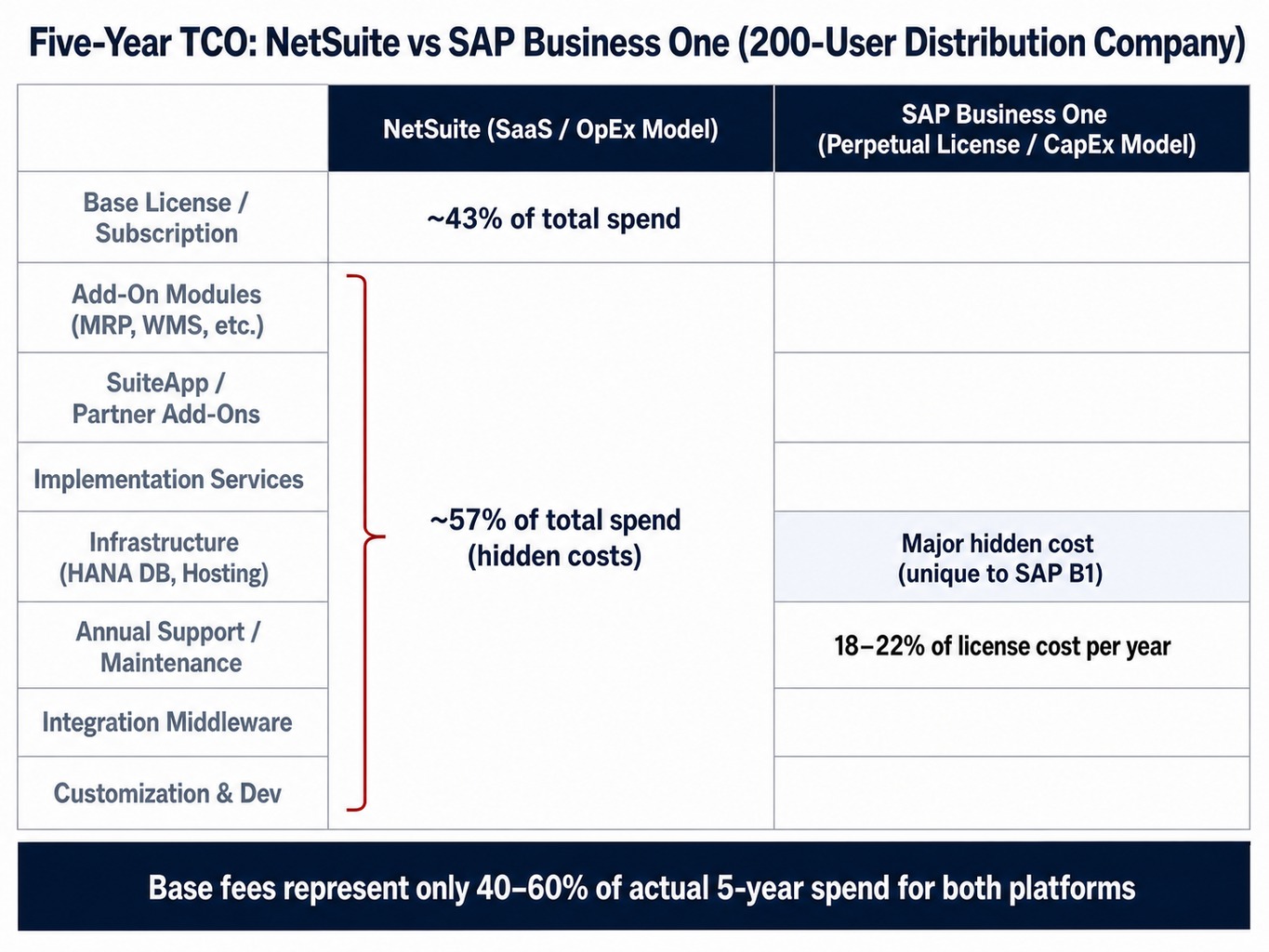
Comparing list prices for Oracle NetSuite vs SAP Business One is an exercise in futility. As most experienced ERP program owners will tell you, the base license or subscription fee typically represents only 40-60% of the actual five-year spend. The real cost drivers are the modules, third-party apps, implementation services, and ongoing support contracts that are rarely detailed in an initial quote.
During a five-year TCO analysis for a 200-user distribution company, the base NetSuite subscription turned out to represent only 43% of the projected spend once SuiteCloud customizations, a third-party WMS connector, and annual user-count true-ups were modeled out. The SAP Business One quote looked cheaper on paper, but not after factoring in the cost of maintaining a dedicated HANA instance and annual support renewals. Neither vendor's pricing page reflected anything close to the real number.
NetSuite: Subscription Pricing and the SuiteApp Tax
NetSuite operates on a per-user subscription model, with costs tiered based on the modules you activate. A base package might cover core financials, but critical functions for manufacturing (Advanced Manufacturing), warehouse management (WMS), or complex contracts (Advanced Revenue Management) are all separate, paid modules.
Then comes the "SuiteApp tax." The SuiteApps marketplace offers hundreds of essential connectors for EDI, shipping, or tax compliance, each carrying its own annual subscription fee. This add-on licensing bloat is a primary driver of cost escalation. Furthermore, companies with heavy integration needs can hit SuiteTalk API call limits, forcing them into higher-priced service tiers or requiring investment in middleware like Celigo or Dell Boomi to manage traffic. The subscription is predictable, but it's a floor, not a ceiling.
SAP Business One: Perpetual Licensing and the Infrastructure Burden
SAP Business One traditionally uses a perpetual license model: a one-time, upfront capital expense for the software, plus an annual maintenance fee of around 18-22% of that license cost. While a subscription model is available for the cloud-hosted version, many choose the perpetual license for its perceived long-term cost advantage.
However, this model carries hidden costs. You must budget for the SAP HANA server infrastructure, whether physical or hosted, plus the cost of a database administrator to manage it. Like NetSuite, core functionality is often extended with paid add-ons from partners like Boyum IT Solutions for advanced manufacturing or warehouse management. The key difference is the cost profile: SAP B1 is a front-loaded capital expense (CapEx) with ongoing infrastructure and maintenance costs, while NetSuite is a more evenly distributed operating expense (OpEx).
Manufacturing and Distribution Fit: MRP, Inventory, and Order-to-Cash
Generic feature checklists are useless for assessing an ERP's fit for your operation. Both platforms "do" inventory management. What matters is how they handle the specific workflows that drive your business, from material planning to final shipment.
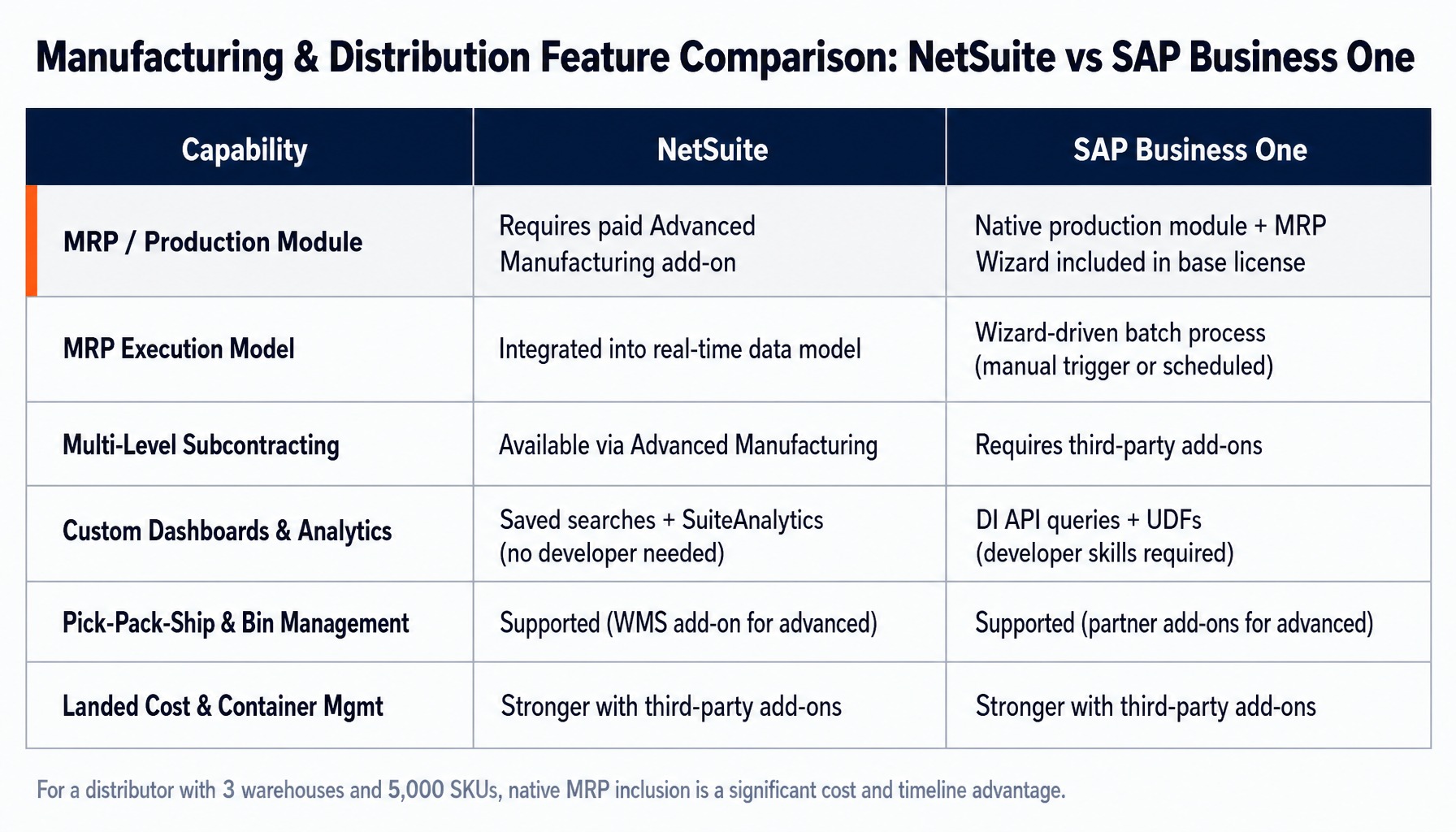
For a mid-market distributor with three warehouses and 5,000 SKUs, the difference is stark. In SAP Business One, the core production module and MRP Wizard are included in the base license. NetSuite, by contrast, requires the purchase of the Advanced Manufacturing add-on to get full MRP, routing, and work center management. This is a significant functional and cost difference out of the box.
SAP Business One's MRP runs as a wizard-driven batch process that must be manually triggered or scheduled. For many manufacturers, this is sufficient. However, it doesn't natively handle complex multi-level subcontracting without add-ons. NetSuite's MRP is more integrated into its real-time data model, but again, it's a feature you pay extra for.
For inventory visibility, NetSuite leverages its powerful saved search and SuiteAnalytics capabilities , allowing users to build custom real-time dashboards without developer help. In SAP Business One, similar custom visibility often requires building queries with the DI API or creating user-defined fields (UDFs) and reports, a more technical task. For distribution, both platforms handle core pick-pack-ship workflows and bin management, but landed cost allocation and container management are often stronger with third-party add-ons in both ecosystems.
The Scaling Ceiling: What Happens When You Outgrow the Platform
Most ERP evaluations focus on today's needs. The more consequential analysis for a CFO or COO is what happens in five years when you've doubled your user count or acquired two new subsidiaries. This is where the platforms diverge significantly.
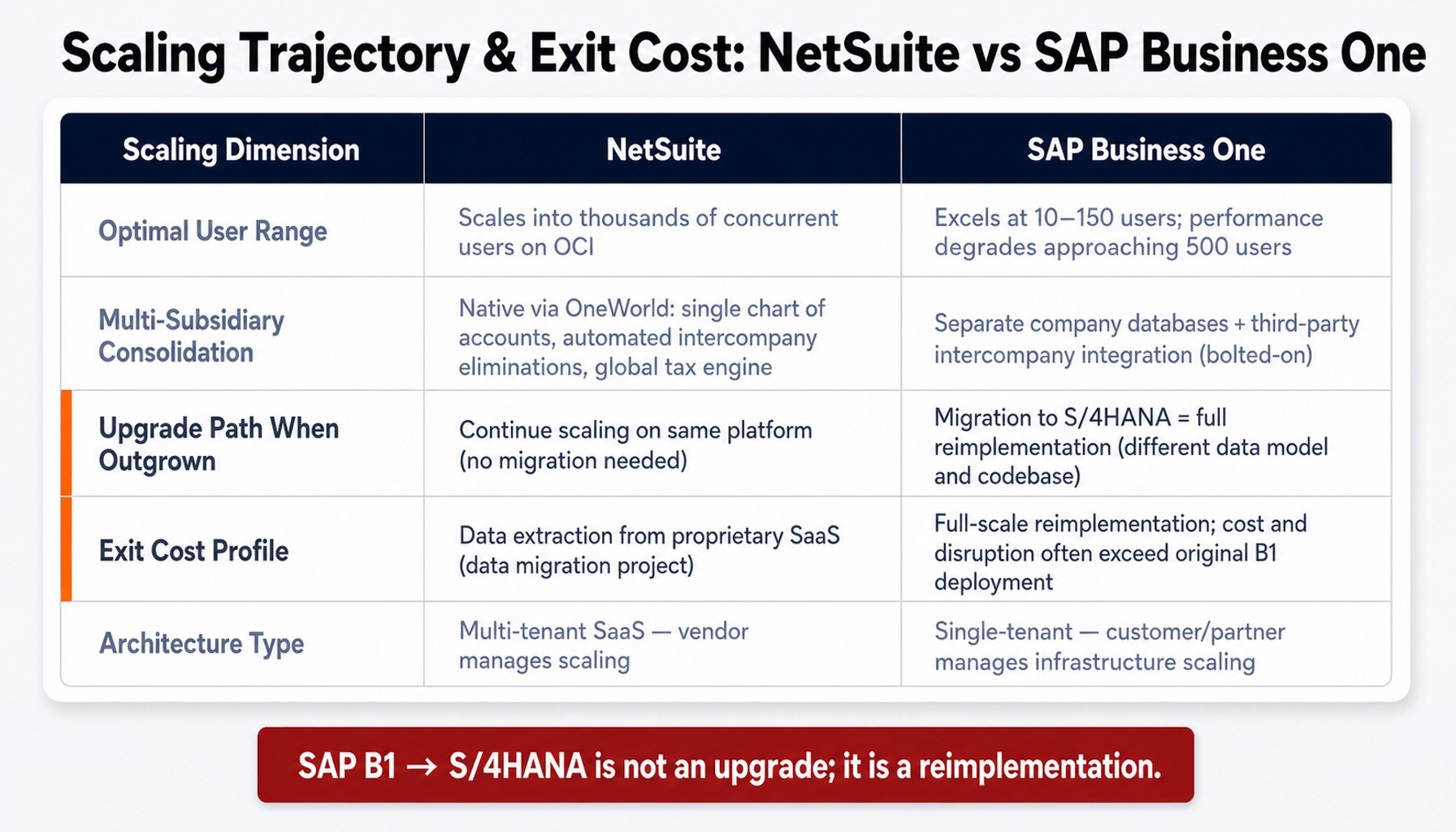
SAP Business One is architecturally designed for the small to mid-market, excelling in the 10 to 150-user range. As you approach 500 concurrent users, performance can degrade, and system administration becomes more complex. NetSuite, built on OCI, is designed to scale into the thousands of users without architectural strain.
The more critical difference is multi-subsidiary management . If your company acquires two subsidiaries in different countries, NetSuite OneWorld handles the consolidation natively. It provides a single chart of accounts, automated intercompany eliminations, and a global tax engine out of the box. With SAP Business One, this requires separate company databases and a third-party intercompany integration solution. It works, but it's a bolted-on process, not a native architecture.
Finally, consider the exit cost. If you outgrow SAP Business One, the logical next step in the SAP ecosystem is S/4HANA. This is not an upgrade; it is a full-scale reimplementation with a different data model and codebase. The cost and disruption often exceed the original B1 deployment. Migrating off NetSuite involves extracting data from a proprietary SaaS environment, a process that can be complex but is fundamentally a data migration project, not a ground-up rebuild.
Integration Ecosystem and Developer Talent Pool
No ERP runs in a vacuum. You will integrate it with e-commerce platforms, EDI providers, and BI tools. Both NetSuite and SAP Business One have mature ecosystems to support this.
NetSuite's SuiteCloud platform is a comprehensive PaaS environment. It includes SuiteScript (a JavaScript-based language) for deep customization, SuiteFlow for visual workflow automation, and SuiteTalk (REST/SOAP) for API-based integrations. The SuiteApps marketplace lists over 650 certified applications.
SAP Business One relies on its Integration Framework (B1iF), DI API, and UI API for customizations. The ecosystem of third-party add-ons and connectors available through the SAP Store is also extensive. Both platforms commonly leverage middleware like Celigo and Dell Boomi for NetSuite, or Workato and SAP Business Technology Platform for SAP B1.
The critical difference for your IT director is the talent pool. In 2026, finding and affording qualified SuiteScript developers is significantly easier than finding SAP B1 SDK specialists. NetSuite's use of JavaScript opens it up to a vast pool of web developers. SAP B1 development requires niche skills in the HANA database layer and SAP-specific APIs, creating a smaller, more expensive talent market.
Upgrade Cadence and Compliance Risk in Regulated Industries
For companies in FDA-regulated manufacturing, life sciences, or food and beverage, an ERP's upgrade model is a core compliance issue. NetSuite's biannual forced upgrades create a predictable but relentless compliance cadence. Before each release, your team must perform regression testing on all customizations and validated workflows in a sandbox environment. You cannot delay the production push.
This stands in stark contrast to SAP Business One's customer-controlled patching. You decide when to apply an update, allowing your quality team to complete all necessary change control documentation, impact assessments, and re-validation on your own schedule. This flexibility is a powerful advantage in environments where any system change is a significant, documented event.
However, this control is a double-edged sword. The discipline to stay current rests entirely on your team. Delaying patches for too long creates security vulnerabilities and significant technical debt, making the eventual upgrade a massive, high-risk project. The choice is clear: NetSuite forces you to maintain compliance currency at the cost of control, while SAP B1 gives you control at the risk of falling behind.
Read more: Unpacking NetSuite's Latest Tools and Updates: How Do They Impact Your Business?
How GSI Helps You Make This Decision With Evidence, Not Vendor Allegiance
The core tension in any ERP evaluation is that the information you need most real cost structures, integration complexities, and scaling limits is precisely what biased vendor partners are least likely to provide. As an Oracle Platinum Partner with over 15 years of experience implementing NetSuite and other enterprise applications, GSI operates as your evaluation ally, not a vendor advocate.
Our approach is grounded in evidence. We help you build TCO models that reflect real-world implementation patterns, not vendor price lists. We architect integration strategies that account for API limits and developer talent. We assess manufacturing workflows to determine where native functionality ends and expensive customization begins. Our 100% service guarantee is a structural commitment to accountability, ensuring the evaluation and implementation process delivers exactly what was scoped. We help you pressure-test your requirements against both platforms so you can make a decision based on operational reality.
Conclusion: The Right ERP Aligns with Your Architecture, Not Just Your Features
The right choice in the NetSuite vs SAP Business One debate is not the platform with the longer feature list. It is the one whose architectural model, cost structure, and scaling trajectory align with your operational reality.
The decision framework is clear. Your architectural DNA determines your upgrade burden and compliance risk. Your five-year TCO will be driven by add-ons and infrastructure costs that vendors omit from quotes. Your manufacturing fit depends on whether core workflows are native or require paid add-ons. And the platform's scaling ceiling determines whether you are buying a five-year solution or a fifteen-year foundation.
Before you shortlist vendors, build your own TCO model using the cost categories in this article. Pressure-test both platforms against your three most complex operational workflows. That exercise will reveal more than any product demo ever could.
Frequently Asked Questions (FAQ)
Is NetSuite overkill for a company with fewer than 50 employees?
Not necessarily. NetSuite's SuiteSuccess editions are designed for smaller deployments with pre-configured workflows. The real question is whether you need multi-subsidiary consolidation, native e-commerce, or plan to scale past 100 users within three years. If the answer is yes, NetSuite's architecture can justify the higher per-user cost even at smaller team sizes.
Does SAP Business One support real-time analytics without SAP HANA?
The SQL Server version of SAP B1 supports standard reporting via SAP Crystal Reports, but true real-time, in-memory analytics require the HANA version. Without HANA, report performance degrades on large datasets. Given that SAP's investment is focused on HANA, new deployments should default to this version to ensure access to modern analytics.
What happens to my SAP Business One license if I want to move from on-premise to cloud?
SAP does not offer a direct license conversion from a perpetual on-premise license to a cloud subscription. Moving to SAP's cloud-hosted Business One typically requires purchasing new subscription licenses, although some partners may offer trade-in credits. This means you should factor in the potential cost of re-buying the software if you change deployment models.
Which ERP has better native e-commerce capabilities?
NetSuite has a distinct advantage with SuiteCommerce, a native e-commerce platform that shares the same database as the ERP, eliminating the need for middleware. SAP Business One has no native e-commerce module. Companies must integrate third-party platforms like Shopify or Magento, which adds integration complexity, cost, and potential points of failure.
How long does a typical implementation take for each platform?
For mid-market companies, NetSuite implementations using the SuiteSuccess methodology typically take 3-6 months. SAP Business One projects range from 3-9 months, with cloud deployments being faster than on-premise installations that require infrastructure provisioning. Both timelines can extend significantly with heavy customization, complex data migration, or multi-subsidiary rollouts.
Which ERP offers better localization for companies operating in multiple countries?
NetSuite OneWorld is designed for this, with native multi-country tax engines and localizations managed centrally. SAP Business One supports over 170 localizations but manages them at the company database level, requiring separate databases for each country and intercompany add-ons. For organizations with more than a few international subsidiaries, NetSuite's centralized model is generally less complex to administer.